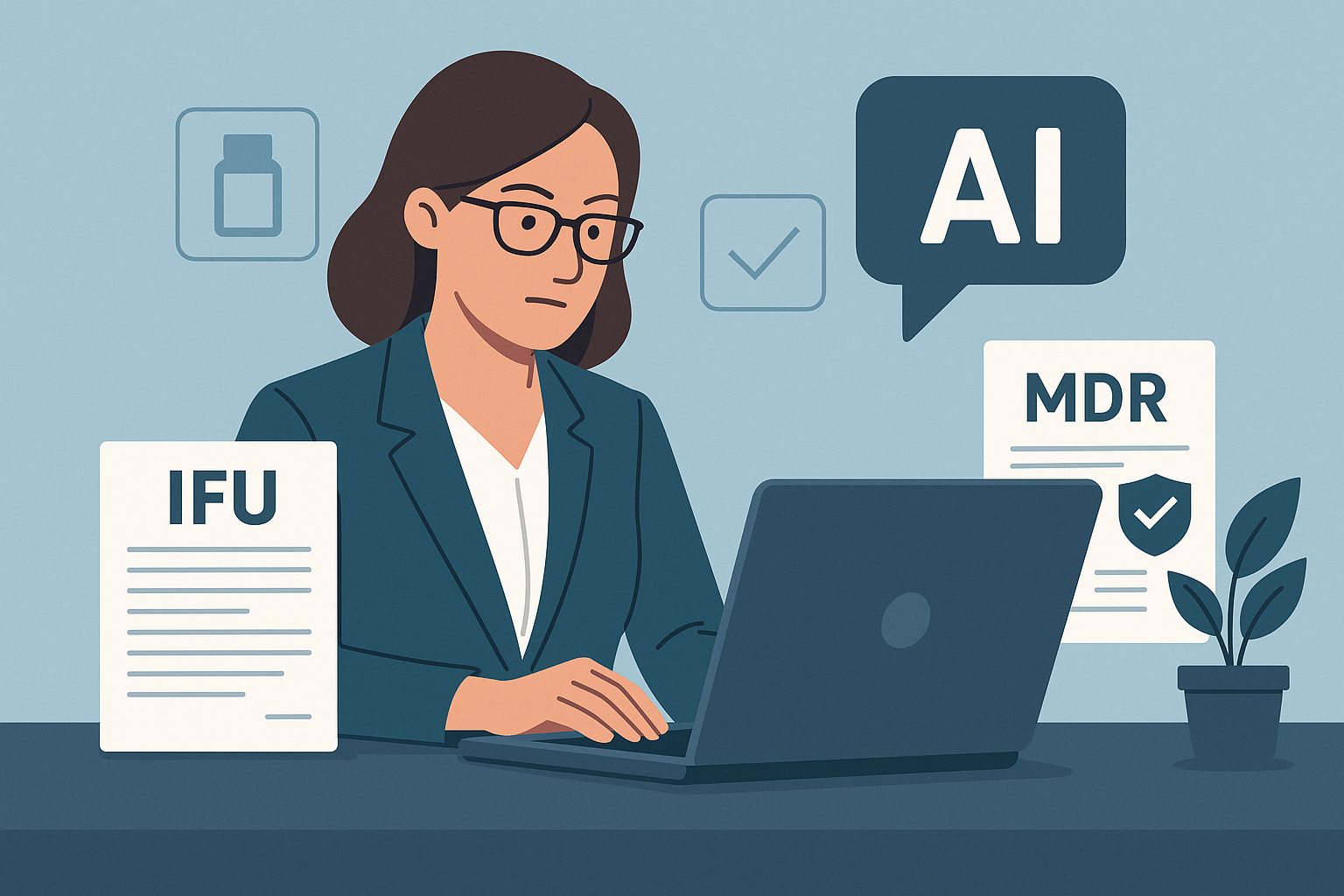
More and more Regulatory Affairs, Quality and Marketing teams are using artificial intelligence to generate an initial translation internally — using tools such as ChatGPT, DeepL or Copilot, as well as corporate AI solutions — and then sending the result to their language services company with an apparently simple request:
“We just need you to review it.”
The logic seems straightforward: if AI has already done much of the work, the review should be quicker and therefore less expensive.
But that is not always the case.
The issue is not whether you use AI for translation. The real challenge is how AI is integrated into the translation process.
A company can achieve significant efficiencies when AI is used as part of a controlled process, with approved terminology and previously translated content, specialist human review and clear version control. The result can be very different when the initial translation is generated outside that process and then sent to another company for review.
This can affect costs, timelines, consistency across documents and, for certain types of content, the traceability of the process.
What changes when the initial translation is generated in-house?
When a language services company manages the entire process, the different stages are connected. The document can be checked against the company’s previous translations, approved terminology can be applied, AI can be used where appropriate, the result can be reviewed by specialists and the necessary quality checks can be carried out.
What is approved in one project can also be reused in future projects
When the client generates the initial translation internally, this first stage takes place outside that process. The language services company receives the text that has already been generated, but may not know what information was used to produce it, which terminology was applied or which previous translations were taken into account. This can create several problems.
AI may not use everything the company has already approved
An AI tool may generate a translation that differs from wording the company has previously used and approved. The linguistic specialist then has to identify the difference and determine which version should be retained.
Approved terminology may be applied too late
An AI tool can produce perfectly natural text while using different terms for the same concept. If the company’s approved terminology is not incorporated from the outset, these variations have to be identified and corrected later.
Applying the right terminology before generating the initial translation is usually more efficient than correcting it afterwards.
The process may become harder to trace
When different tools, teams and companies are involved at different stages, it can become harder to establish which tool generated a piece of content, what instructions it received, which version of the source document was used and who ultimately approved the result.
For regulated or safety-related content, this traceability can be particularly important.

“Just review it” can mean very different things
There is also an important difference between reviewing a text and ensuring that an AI-generated translation is ready for use.
A review might involve correcting obvious errors. Depending on the content, however, it may also be necessary to check that nothing has been omitted, that the meaning has been preserved, that terminology is correct, that figures and units match and that the text is fit for its intended purpose.
ISO 18587 sets requirements for the human review of machine-generated translations. This means that when a company uses AI to generate a translation and needs a professional-quality result, the review process needs to match the level of quality required.
This is why a request such as “just review it” can be too vague.
Before requesting a quotation, it is worth defining:
- which tool generated the initial translation;
- what information the tool was given;
- which terminology and previous translations were used;
- what level of human review is expected;
- how the document will be used;
- which quality checks need to be carried out;
- who will be responsible for final approval.
The difference between a basic check and a full professional review can have a significant impact on both cost and turnaround time.
Where is the real cost?
The cost of reviewing an AI-generated translation may seem straightforward to calculate. In practice, it depends largely on the quality of the initial translation received by the language specialist.
A text may appear fluent while still containing issues that require in-depth review: an omission, a term replaced with one that is inappropriate in context, a modified figure or a sentence whose meaning has subtly changed.
To understand the real cost of an AI-assisted translation process, it is therefore worth considering several factors.
-
The quality of the initial translation
This will depend on the language, the tool used, the type of content and the information provided to the system.
An initial translation generated without terminology, context or specific instructions may require considerably more work than one produced as part of a controlled process.
-
The level of review required
Not all documents require the same level of control. An internal document may require a different level of review from a package leaflet, instructions for use, informed consent form or regulatory document.
The intended use of the document should determine the level of quality required.
-
Additional work
If the scope of the review is not clearly defined from the outset, the amount of work can increase during the project, particularly when additional rounds of comments or internal changes are introduced.
What initially looked like a quick review can end up requiring a full review, with a deadline that was never planned for.
-
The use of previous translations
This is one of the less visible costs. If an AI-generated translation that has not yet been reviewed is added to the company’s translation resources as though it had been approved, the same errors can reappear in future projects.
A decision that initially appears efficient can therefore create additional work for months to come. This is why content added to a company’s translation resources should have a clear validation and approval status.
-
Terminological consistency
Using different terms for the same concept within a dossier, product family or set of materials can become a quality issue.
The later it is identified, the more documents may be affected.
-
Coordination and version control
When different tools, teams and companies are involved, the number of versions and coordination points increases. It can also become harder to reconstruct the complete process during an audit or internal review.
All these factors contribute to the real cost of the translation process, beyond the price per word.
A seemingly lower unit price may prove less efficient if the initial translation requires much more review than expected, does not make use of the company’s previous translations and creates additional work in future projects.
Two Ways of Using AI: A Fragmented Process vs an Integrated Process
The difference between the two models is not simply who generates the initial translation. It is about what information is available at each stage and what knowledge is carried forward to the next project.
| Criteria | In-house AI + external review | Integrated process |
| Starting point | Initial translation generated outside the language services company’s environment | The source text is assessed alongside approved translations and terminology |
| Terminology | Corrected during review | Applied from the outset |
| Review | The scope may be unclear | Defined according to the intended use and required quality level |
| Timelines | The actual workload may become clear later | The workload is assessed from the start |
| Changes to the source | It may be difficult to establish which version the initial translation relates to | Versions and changes are controlled |
| Traceability | May be spread across different tools and teams | The process is documented centrally |
| Previous translations | May not be used | Incorporated from the outset |
| Future terminology | May remain fragmented | Updated and reused across future projects |
| Process control | Different parties are involved at different stages | One coordinated process manages the different stages |
Neither model is necessarily right or wrong.
The key question is what level of control the content requires and what the company is trying to achieve by using AI internally.
How to Assess Your Current Process
A simple way to assess your current approach is to ask the following questions.
About the initial translation
- Which tool generates the initial translations, and who decides which one to use?
- Has it been internally approved from a security and confidentiality perspective?
- What information is entered into the tool?
- Could it include confidential information, details of products that have not yet been launched or patient information?
- Does the tool use your company’s approved translations and terminology?
About the language services company
- Does the brief specify the level of review you expect, or does it simply say “review”?
- Does the language services company know which tool generated the initial translation?
- Does it have access to the relevant instructions used to generate it?
- Have you ever compared the cost of reviewing the internally generated translation with the cost of managing the same content through a complete translation process?
About the final result
- Are approved translations added to your company’s translation resources?
- Is terminology updated after each project?
- When the source document changes, can you easily identify which translated version corresponds to each source version?
- If an auditor asked tomorrow how a particular document had been translated, could you reconstruct the process from beginning to end?
These questions are not simply about assessing the AI tool.
They are about assessing the entire process.
Warning Signs: Is Your Process More Fragmented Than You Think?
There are several signs that your current approach may need to be reviewed.
For example:
- review times become longer every time the source document changes;
- the language services company repeatedly identifies quality issues in the initial translations;
- the same term appears in different forms across related documents;
- no one can say with certainty which tool was used to generate an older document;
- internally generated translations appear to save time, but the saving is not clearly reflected in the overall cost;
- each project requires the same terminology preferences to be explained again;
- previous company-approved translations are rarely used or include content that has not yet been properly validated.
If several of these situations are familiar, the problem may not be the AI tool itself. It may be the way it has been integrated into the process.
When Does It Make Sense to Use AI Internally?
None of this means that companies should not use AI for translation. On the contrary: AI can deliver significant value when it is used as part of the right process.
The decision should be based on the type of content, its intended use and the level of risk involved.
Lower-risk content
For internal content that will not be shared with patients, customers or authorities — such as meeting notes or an initial review of scientific literature — an AI tool may be perfectly appropriate, provided its use is compatible with the company’s security and confidentiality policies.
Medium-risk content
For certain marketing materials, internal communications or training content, it may be appropriate to use AI as part of a professional process, drawing on previous translations and approved terminology and followed by specialist human review.
Higher-risk content
For instructions for use, package leaflets, informed consent forms, protocols, safety documentation or certain regulatory documents, a much higher level of control is required.
In these cases, a process managed by specialists may be appropriate, with quality checks, traceability and human review in accordance with ISO 18587 when an AI-generated translation is used.
The classification of the content and the level of control required should be decisions for Quality and Regulatory Affairs, not solely for Procurement or the language services company.
AI Does Not Eliminate the Need for a Process
The question should not be reduced to “AI works” versus “AI fails”.
Performance depends on the language, the tool, the type of content and the context provided to the system. A text that looks correct at first glance may still contain errors that alter its meaning.
For healthcare and regulated content, the important question is therefore not simply how good the initial translation looks, but how the final result is controlled and validated.
AI can be a powerful productivity tool. It does not, by itself, remove the need for controlled terminology, specialist human review, quality checks and traceability when the content requires them.
How We Work at Lexic
At Lexic, we work with an integrated translation and specialist human review process.
Where available, each project starts with the client’s previous translations and approved terminology. When we use AI, it is integrated into the translation process, and the resulting content is reviewed by specialists with experience in medical and scientific content.
Our processes are certified to ISO 17100 and ISO 18587, and the level of human involvement is adapted to the type and intended use of the content. This means that AI does not operate as a separate step before the professional language work begins. It forms part of a process in which previous translations, terminology, human review and quality control are connected.
Approved content can also be used to strengthen the language resources available for future projects. For clinical trial or Regulatory Affairs content, this approach can be integrated with our specialist services in these areas.
If your team is deciding which parts of its translation process to manage internally and which to outsource, it is worth assessing the entire process before focusing solely on the price per word. The conversation should involve Quality and Regulatory Affairs, as well as Procurement, particularly when dealing with critical content.
Frequently Asked Questions
Is reviewing an AI-generated translation cheaper than translating from scratch?
It can be, but not necessarily.
It depends on the quality of the initial translation, the language, the type of document, the level of review required and whether the language services company has access to the company’s previous translations and approved terminology.
When the initial translation is provided without this context, the amount of review required can be much greater than expected, and some of the initial saving may disappear.
What is the difference between reviewing an AI-generated translation and carrying out a full review?
A review can involve different levels of intervention depending on the project. When AI is used to generate a professional translation, ISO 18587 sets requirements for human review of the output. The aim is to ensure that the final text is accurate, complete, consistent and fit for purpose.
This is why it is important to define exactly what the final result is expected to achieve before requesting a quotation.
Can ChatGPT or a similar tool be used to translate regulated documentation?
It can form part of a managed translation process when the use of the tool is compatible with the company’s security and confidentiality requirements and the resulting content is subject to the level of review and quality control required for that type of document. However, an AI-generated draft should not be confused with a validated final translation.
For regulatory, safety-related or patient-facing content, it is particularly important to define who is responsible for final approval, what checks are carried out and how the process is documented.
What happens if an AI-generated translation is then used in future projects?
If it is added to the company’s translation resources without being properly reviewed and approved, it can introduce errors or unvalidated terminology that may then be reused in future projects.
This is why translations added to these resources should always have a clear validation status.
How can I tell whether my translation process is fragmented?
There are several indicators. If the initial translation is generated outside the language services company’s environment, if previous translations and approved terminology are not used at that stage, if the language services company receives only the already-generated text and if it is difficult to reconstruct who did what on an older document, there is likely some degree of fragmentation.
The questions in the assessment section above can help you identify where this is happening and what impact it may be having.
Are you really saving time and money with AI?
If your company is already using AI to generate translations in-house, we can help you assess the process as a whole: which content is suitable for AI, what level of human review each type of content requires, and where hidden costs or risks may be arising.
Tell us how you are currently working, and we’ll review your process with you to identify opportunities to improve efficiency.