A medical device may meet all the relevant technical and regulatory requirements and still encounter problems when entering a new market if its documentation has not been translated correctly.
In the MedTech sector, translation is not simply about transferring technical information from one language into another. Instructions for use, labelling, technical documentation, software, patient materials and clinical documentation must communicate information accurately while also meeting the linguistic and regulatory requirements applicable in each market.
A terminology error, a poorly translated warning or an interface that has not been properly adapted to the target language can lead to queries during conformity assessment, delay a product launch or affect the user experience and safety.
For this reason, medical technology companies need a language partner that understands not only the content being translated, but also the regulatory and user context in which that content will be used.
What Makes MedTech Translation Different?
Medical device translation combines three requirements that rarely carry the same level of importance in other sectors: terminological accuracy, knowledge of the regulatory environment and an understanding of the end user.
A single product may include documentation intended for a Notified Body, instructions for healthcare professionals, patient information and commercial content. Although all of these materials relate to the same product, they serve different purposes and require different levels of specialisation.
A translation intended for a Notified Body must be technically rigorous and consistent with the existing regulatory documentation. Instructions for use must enable users to understand exactly how to use the product and what precautions to take. A medical application, meanwhile, needs to provide a clear and intuitive user experience without compromising technical accuracy.

This diversity means that MedTech translation requires much more than linguistic expertise. Translators need to understand sector-specific terminology, how the product works and how to apply consistent terminology and criteria across all related documents and language versions.
The sector is also constantly evolving. New technologies, software as a medical device, AI-powered diagnostic solutions, connected devices and remote monitoring solutions are continually expanding the range of content that needs to be localised.
What Documentation Needs to Be Translated in MedTech?
Commercialising a medical device across different markets involves managing a substantial volume of interconnected documentation.
This may include:
- instructions for use (IFUs);
- labelling and packaging;
- technical documentation;
- product specifications and documentation;
- clinical evaluation documentation;
- risk management documentation;
- post-market surveillance documentation;
- clinical trial reports and documentation;
- materials for patients and healthcare professionals;
- training materials;
- catalogues and commercial materials;
- digital content and software.
Each type of document presents different challenges.
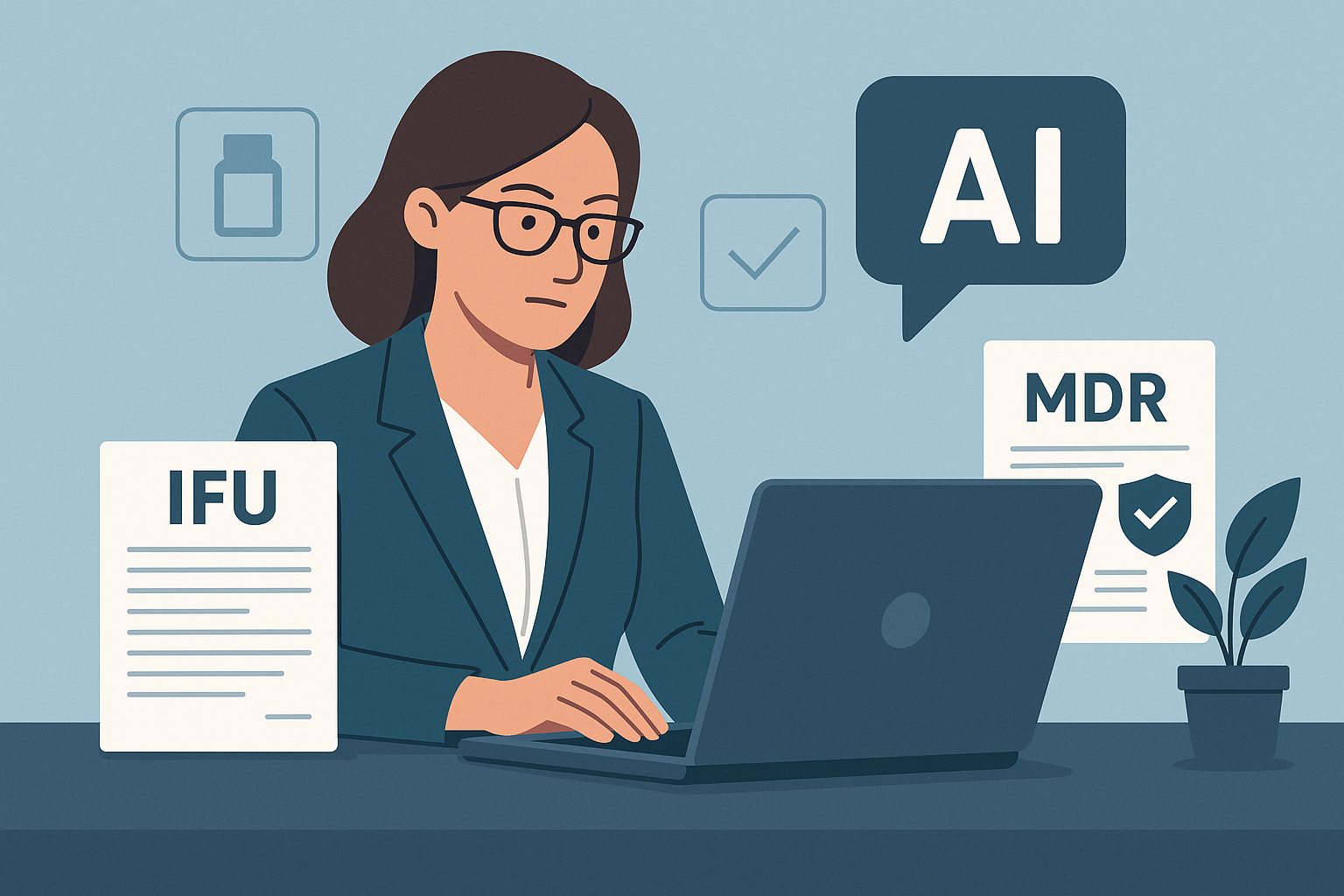
For an IFU, for example, the priority is to ensure that instructions, warnings, contraindications and precautions are unambiguous and consistent with the rest of the product documentation.

In technical documentation, it is essential to maintain consistent terminology and ensure that the translation accurately corresponds to the original and previously approved versions.
For patient-facing materials, the challenge may be different: the information must be clear and easy to understand for people without specialist knowledge, while retaining full medical accuracy.
This is why it is not enough to apply the same translation workflow to every piece of content within a project. The criticality and purpose of each document should determine the level of specialisation, review and quality control required.
Medical Software: When Translation Is No Longer Enough
The growth of the MedTech sector is no longer limited to physical devices. Medical software plays an increasingly important role, from mobile applications and monitoring platforms to clinical decision-support systems, patient portals and software integrated into medical devices.
In these projects, translating text strings in isolation is not enough.
Medical software localisation must take into account how content is actually displayed and used within the interface. Language can affect text length, available space, buttons, menus, error messages, date and time formats, units of measurement and navigation.
For example, a linguistically accurate translation may still be unsuitable if a button no longer displays its full text, a warning is truncated or an instruction becomes unclear within the interface.
For this reason, localisation should be integrated into the product development cycle and, where necessary, include linguistic and visual testing in the actual user environment.
This approach makes it possible to identify and resolve issues before launch, when changes can still be made without affecting the product timeline.
MDR, IVDR and Language Requirements
Regulation (EU) 2017/745 on medical devices (MDR) and Regulation (EU) 2017/746 on in vitro diagnostic medical devices (IVDR) have strengthened the requirements applicable to manufacturers placing these products on the European market.
Language requirements form part of this regulatory framework. Information accompanying a product must be available in the languages required by the Member States where it is placed on the market and must meet the requirements applicable to the type of product and its intended users.
This means that translation cannot be treated as a separate stage from the regulatory strategy.
Documentation must remain consistent with the technical documentation and with the rest of the product information. In addition, certain content may be subject to specific requirements relating to format, presentation, symbols or legibility.
During the conformity assessment process, any linguistic inconsistency can result in queries, requests for amendments or additional work for the manufacturer.
Working with a language partner familiar with the MDR and IVDR environment therefore helps reduce the risk of linguistic issues and facilitates the coordination of multilingual documentation intended for Notified Bodies and national competent authorities.
The Importance of Terminological Consistency
In MedTech projects, translation quality is not measured solely by the absence of linguistic errors. It also depends on ensuring that all documents relating to a product use consistent terminology.
An approved term for a component, function, warning or product feature should be used consistently across the IFU, labelling, technical documentation, software and training or marketing materials.
This becomes even more important when a product is updated.
A design modification, a new software version or a change to an instruction may require several documents and languages to be updated simultaneously. Without a product-specific translation memory, an approved glossary and a robust version control system, the risk of reusing outdated terminology or introducing inconsistencies between documents increases.
Terminology management is therefore more than a tool for improving linguistic consistency. It is a way of managing documentation risk throughout the product lifecycle.
What Should a Specialist MedTech Language Partner Provide?
Choosing a language services provider should not be based solely on the price per word or the ability to deliver a document quickly.
For medical device projects, a specialist partner should be able to provide:
- translators and reviewers with specific MedTech experience;
- expertise in technical and regulatory terminology;
- experience with MDR and IVDR documentation;
- glossary and translation memory management;
- version control and traceability;
- independent linguistic review;
- quality control tailored to the risk level of the content;
- DTP and in-context artwork review;
- software localisation and testing;
- the capacity to manage complex multilingual projects.
The workflow should also be adapted to the type of content.
For critical documentation, a human translation and revision process in accordance with ISO 17100 may be appropriate. For other types of content, machine translation with professional post-editing can provide greater efficiency, provided that it is managed in accordance with the requirements of ISO 18587 and the risk level of the project.

The objective is not to use the same technology or workflow for every project, but to select the approach that provides the right balance between quality, safety, compliance and efficiency.
Lexic’s Experience in MedTech Translation
At Lexic, we have been working for more than 10 years with healthcare companies, medical device manufacturers and medical technology companies on translation and localisation projects.
Our team combines linguists specialised in life sciences with reviewers experienced in the technical, regulatory and clinical documentation specific to the sector. We work across more than 60 language combinations and hold UNE-EN ISO 17100:2015 and ISO 18587 certifications for our human and machine translation workflows.
Our experience ranges from instructions for use, labelling and technical documentation to clinical documentation, training materials, medical software and marketing content.
Each project is assessed according to the product, the type of documentation, the target market and the level of risk involved, allowing us to define the most appropriate team and workflow.
If your company needs to translate regulatory or marketing documentation related to medical technology, request a quote and we will recommend the most appropriate team and workflow for your project.