This interview marks the start of a new series spotlighting professionals from across the translation, interpreting and localisation landscape. Through these conversations, we want to shine a light on the people behind the profession — their journeys, perspectives and lived experience — and to explore how an industry in constant motion continues to redefine itself. It is also an opportunity to reaffirm the importance of the human element in a field where technology is moving at remarkable speed, yet where experience, sound judgement and professional expertise remain decisive.
We begin the series with conference interpreter Tatiana Salaet, whose career provides a compelling perspective on the challenges and transformations shaping the profession today.
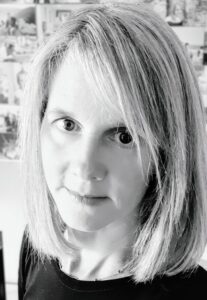
Tatiana Salaet has been working as a conference interpreter since 1999. She holds a degree in Translation and Interpreting from Pompeu Fabra University in Barcelona (1998), an MA in Conference Interpreting from the University of La Laguna (1999), and an MA in International Studies from CIDOB (affiliated to the Autonomous University of Barcelona, 2008).
She is accredited as a freelance interpreter by the EU institutions — the European Commission, the European Parliament and the Court of Justice of the European Union. She is also a sworn translator and interpreter for English, officially recognised by Spain’s Ministry of Foreign Affairs, and a member of the prestigious International Association of Conference Interpreters (AIIC).

Q: If you had to describe the profession today in one sentence, what would it be? And what has changed most over the past 3–5 years?
A: Interpreters are like polar bears — a species in constant adaptation and hybridisation.
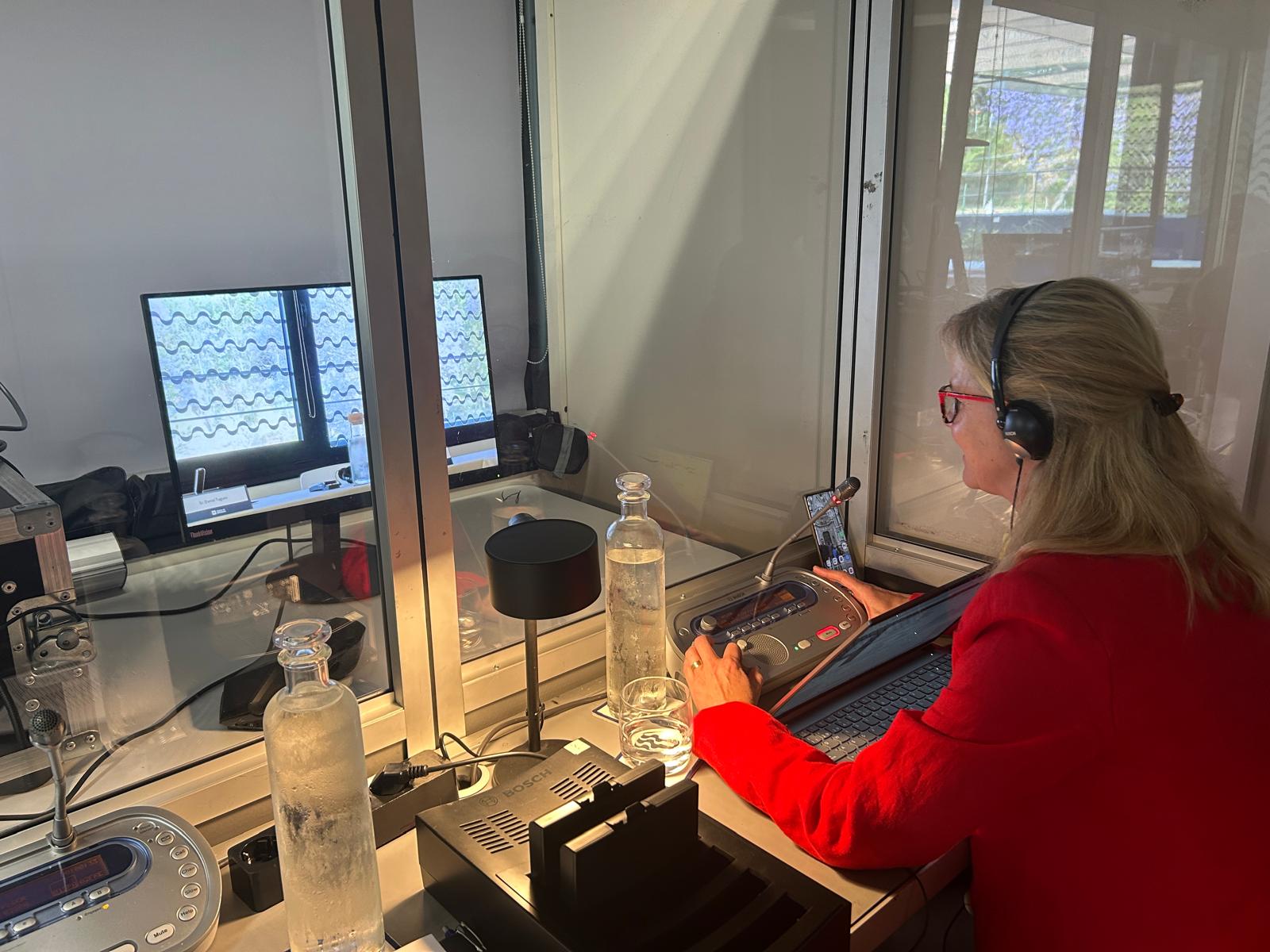
With the rise of remote and online interpreting, technology has taken centre stage in our professional lives. We now work through digital platforms — Zoom, Teams and many others. An interpreter no longer simply listens, processes and reformulates a speech into the target language. We are also managing platform controls, monitoring chats to coordinate with our booth partner, and juggling multiple technical tasks at once. It’s multitasking taken to the extreme.
Sound quality is not always ideal either. Technical support is sometimes absent, leaving interpreters at the mercy of participants’ microphones and internet connections. The overall context is arguably more stressful and demanding than ever.
Another added challenge is speakers reading out written statements at speed. At that point, interpretation can feel less like interpretation and more like delivering a rapid-fire reading in another language — as fast as vocal cords and neurons will allow.
Q: What sets a medical-scientific interpreter apart from other profiles (beyond simply “knowing the terminology”)?
A: Medical-scientific interpreting requires solid prior experience as a conference interpreter. The speed, the density of acronyms and highly specialised terminology, and the depth of subject knowledge required make it a genuine challenge.
Meticulous preparation is essential: reading extensively, assimilating complex concepts and mastering key terminology to avoid hesitation during delivery. Anticipation is more difficult, and synonymy is rarely an option — each term refers to a precise, non-interchangeable concept.
It also requires a higher tolerance threshold for certain images or live demonstrations, which can sometimes be quite graphic.
Q: How do you prepare for a highly technical session (e.g.oncology, pharmacovigilance, implants) when the briefing arrives late or incomplete?
A: Documentation is always the foundation of good preparation. Unfortunately, materials sometimes arrive at the last minute — but that’s not an excuse.
With today’s technological resources, interpreters can research the topic thoroughly, read scientific articles and compile specialised glossaries by extracting terminology from their readings. We consult databases in our working languages, research the pharmaceutical company or laboratory presenting a new product, and look into the profiles of the speakers.
All of this preparatory work is intrinsic to the profession. It’s part of the job.
Q: Can you share an anecdote (without sensitive details, of course) that illustrates a typical challenge in medical-scientific interpreting? A “please let the ground swallow me up” moment?
A: As I mentioned earlier, medical-scientific interpreting is not for the faint-hearted. I vividly recall an implantology congress where trainees were required to practise placing implant abutments on cadaver heads — on site.
On another occasion, a patient undergoing a live aesthetic procedure suffered a panic attack due to the pain caused by the injections and burst into tears mid-demonstration.
Q: Is there a speaker or public figure you found particularly impressive to interpret, and why?
A: Without hesitation: Stéphane Hessel, whom I had the immense honour of interpreting in 2009.
A survivor of Buchenwald concentration camp, he contributed to drafting the 1948 Universal Declaration of Human Rights and later authored Time for Outrage! (2010), calling on young people to stand up to a world gripped by financial interests.
Many years have passed, yet he left an indelible mark on me — through his resilience, determination and profound humanism.
Q: Back to the medical field, interpreting has shifted significantly towards remote formats. What have we gained — and what have we lost?
A: Remote interpreting allows for better work–life balance and, in the medical and scientific sphere, enables more events to take place thanks to reduced travel and accommodation costs. It is also more sustainable. In that sense, it is positive — as is the possibility of providing interpreting services at conferences that might previously have been held exclusively in English.
However, the physical distance from the event adds mental fatigue. Remote work demands greater concentration and involves dealing with unstable connections or speakers who misuse microphones.
Interpreters must divide their attention between multiple tasks: managing their digital console, monitoring a messaging channel to communicate with their virtual booth partner, adjusting slides on screen, and isolating themselves from background noise in their workspace.
In short, the cognitive load is significantly higher in remote settings.
Q: Let’stalk about technology. When you hear “AI” in medical-scientific interpreting, where does it genuinely help today — and what feels like hype? Where do you see real added value, and where is it not ready yet?
A: AI already helps us save time and improve efficiency. Various tools can generate specialised multilingual glossaries in seconds. Machine translation is now widely used, and between closely related languages the results can be impressive.
In that sense, AI is a tool at our disposal, and it would be presumptuous not to acknowledge its usefulness.
However, I do not believe AI can replace the empathy required in certain medical contexts. Nor can I easily imagine a machine capturing the subtle irony of some speakers or adapting seamlessly to the cultural context of the target audience.
For now, I trust that human interpreting remains two steps ahead of automated solutions.
Q: Looking ahead, how do you see the profession evolving over the next 2–3 years with AI, automatic subtitling and support tools? What needs to change to protect quality and security?
A: After nearly six years of platform-based remote interpreting and the current surge in AI tools, our profession has continued to adapt — much like Arctic polar bears.
It is also true that interpreters depend greatly on their speakers. We are not authors; we are messengers.
AI may assist — or perhaps replace — us when the original speech is flat, with few nuances, limited cultural references and little emotional charge. For now, however, intuition, empathy, irony and humour remain beyond the reach of machines.
As for security and confidentiality, only strict adherence to professional ethics can safeguard sensitive information. Our code of conduct requires rigour, sound judgement and professional integrity — values every interpreter understands clearly.
Algorithmic bias, by contrast, will depend on the regulatory strategies adopted by governments. At present, much of this technology remains in the hands of a powerful tech elite, and cybersecurity is still very much a work in progress.